 +44 (0) 20 7127 5125
 Alumni Login
The AoEC’s consultancy services are offered to organisations and feature a portfolio of tailored coaching based solutions and products that can serve to address a multitude of issues facing both large and small businesses today.
Why coaching is a compound interest strategy for talent
20th January by Lucy Tulloch
Reading time 4 minutes
Share this article:


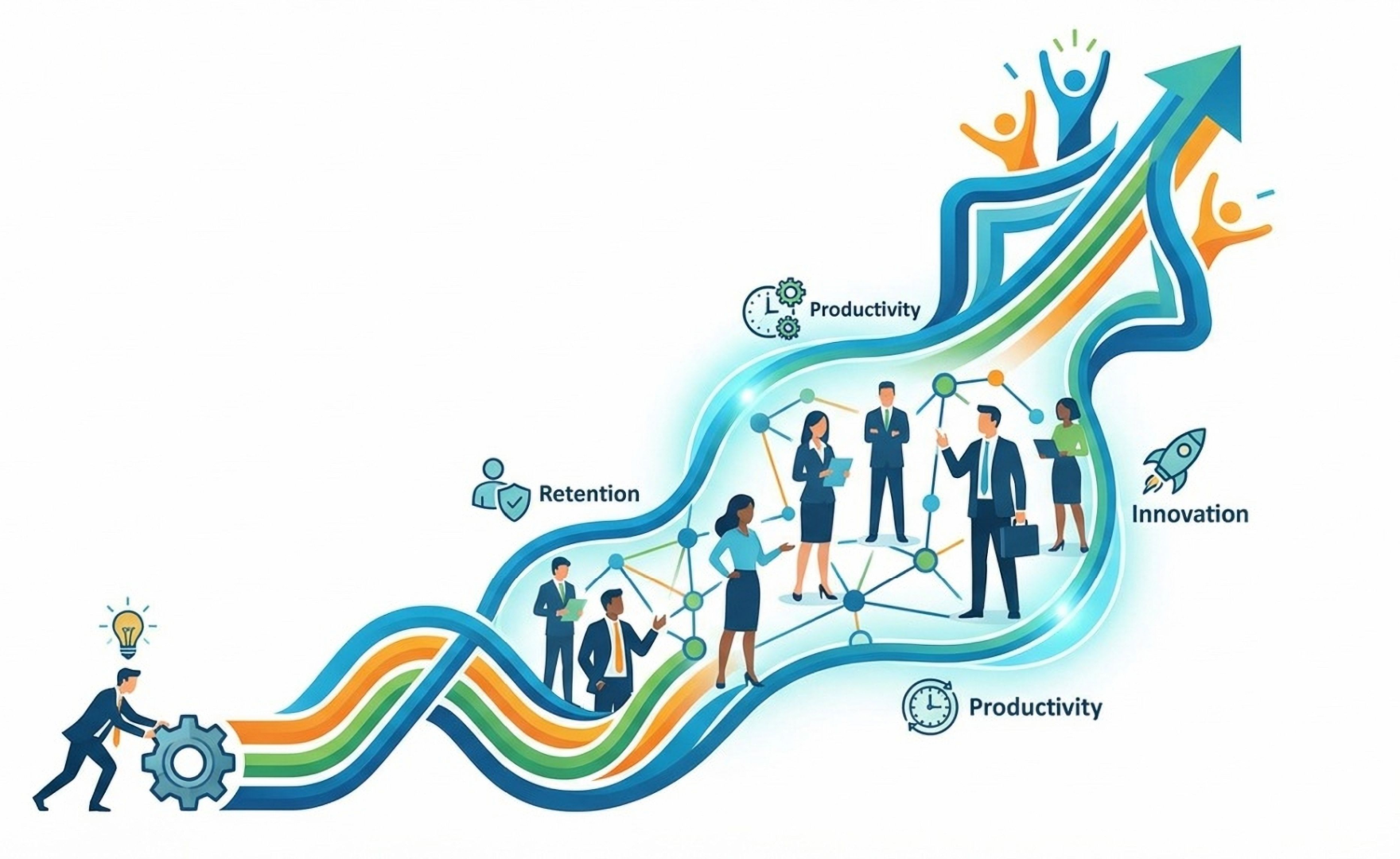
Organisations today are operating in a climate of constant complexity. Markets shift quickly, technology accelerates change and talent is harder to retain. In this environment, every investment is under scrutiny - and every decision needs to deliver measurable value. That’s why coaching deserves a fresh look: it isn’t a cost; it’s a compound interest strategy for talent that pays back over time.
Leaders know that budgets are tight and expectations are high. CFOs and CEOs want proof that learning initiatives move the needle and L&D teams are under growing pressure to show impact. Research from Watershed reveals that 60 per cent of L&D managers face increasing executive demands to measure learning’s value. Against this backdrop, coaching stands out - not as a discretionary extra, but as an economic multiplier that drives retention, productivity and innovation.
Coaching through the CFO’s eyes
For years, coaching has been framed as a developmental tool, often championed by HR and L&D teams. But when viewed through an economic lens, its impact becomes far more strategic. Coaching doesn’t just improve individual performance; it compounds organisational value over time.
Think of coaching like compound interest. The initial investment – whether in executive coaching, team coaching or building internal coaching capability – generates incremental gains that accumulate. Employees who feel supported and equipped to navigate complexity stay longer, perform better and contribute more creatively. As Keith Keating notes in Hidden Value:“As organizations face unprecedented change and complexity, L&D’s ability to articulate and deliver value becomes increasingly critical.”
Retention: the cost of losing talent
Replacing a senior leader can cost up to two times their annual salary when you factor in recruitment, onboarding and lost productivity. Multiply that across multiple roles and the financial risk becomes clear. Coaching mitigates this by increasing engagement and loyalty. When leaders and teams feel invested in, they’re less likely to jump ship – even when competitors dangle attractive offers.
Retention isn’t just about keeping people; it’s about keeping the right people.
Coaching helps organisations identify and nurture high-potential talent, ensuring succession pipelines remain strong. For CFOs, that translates into reduced churn costs and a more predictable workforce strategy.
Productivity: beyond training
Traditional training often delivers a short-term spike in knowledge but fails to embed behavioural change. Coaching bridges that gap by creating accountability and personalisation. It turns learning into action, ensuring that new skills translate into measurable performance improvements.
Consider the productivity gains when managers learn to coach their teams effectively. Instead of firefighting, they empower employees to solve problems independently, freeing up leadership bandwidth for strategic priorities. Over time, this cultural shift reduces inefficiencies and accelerates decision-making – a direct boost to operational performance.
The 2025 No Train No Gain report from the Learning and Work Institute reinforces this point: workers who receive training earn more, progress faster and are better equipped to change careers when needed. Training and coaching together underpin career progression and help organisations adapt to structural change – a critical advantage in a labour market where job mobility is slowing and skills demand is rising.
Innovation: the hidden ROI
In uncertain markets, innovation is the ultimate hedge against obsolescence. Yet innovation doesn’t happen in a vacuum; it thrives in environments where psychological safety and adaptive thinking are the norm. Coaching fosters both.
By encouraging reflection, curiosity and resilience, coaching equips leaders to challenge assumptions and explore new solutions. Teams coached to collaborate effectively generate ideas faster and execute with greater confidence. For CEOs focused on long-term competitiveness, this is where coaching delivers its most compelling return: future-proofing the organisation.
The CFO’s checklist: measuring impact
One reason coaching is sometimes overlooked in boardroom discussions is the perceived difficulty of measuring ROI or ROE. But the metrics are there if you know where to look:
- Retention rates among coached employees vs. non-coached peers
- Productivity indicators such as project delivery times and quality scores
- Engagement scores and their correlation with performance outcomes
- Innovation metrics, including new product launches or process improvements
As Rebecca J. Jones advises in Coaching with Research in Mind: “Wherever possible, measure a range of outcomes, ideally from each of the four types of outcomes in the coaching outcome framework (affective, cognitive, skills-based and results).” When these data points are tracked over time, the economic case for coaching becomes undeniable. It’s not about soft benefits; it’s about hard numbers that speak the language of finance.
From cost centre to value driver
The shift in perspective is critical. Coaching should not sit in the “cost centre” column of the spreadsheet; it belongs in the “value driver” column.
Organisations that cut coaching often find themselves paying more later – through higher attrition, stalled projects and missed opportunities. Those that double down on coaching, however, emerge stronger, leaner and more innovative.
Making the case to the board
So how do you position coaching as an economic multiplier in conversations with CFOs and CEOs? Three strategies stand out:
- Lead with data, not anecdotes. Quantify the cost of attrition, the productivity gains from coaching managers and the innovation outcomes linked to team coaching.
- Frame coaching as risk mitigation. In volatile markets, leadership capability and workforce resilience are insurance policies against disruption.
- Connect coaching to strategic priorities. Whether it’s digital transformation, cultural change or market expansion, show how coaching accelerates these goals.
The compound interest effect
The beauty of coaching is that its benefits are cumulative. A leader who learns to coach today will influence dozens of employees over their career. A team that adopts a coaching mindset will cascade that behaviour across the organisation. Each interaction compounds the value of the original investment, creating a virtuous cycle of growth and performance.
In financial terms, that’s the definition of a high-yield strategy.
Conclusion: coaching as economic strategy
In a tight economic climate, organisations can’t afford to think of coaching as a luxury. It’s a lever for retention, a catalyst for productivity and a driver of innovation. Viewed through the economic lens, coaching isn’t just an investment in people – it’s an investment in organisational resilience and competitive advantage.
If you would like to discover more about coaching and training as a coach, do come along to one of our free upcoming virtual open events or webinars.
Article
Why coaching confidentiality matters
7th April 2026 by Lee Robertson
A recent report in HRDive about a senior executive at a major entertainment company alleging that HR sought access to…
News
AoEC appoints Virginia Molet to head Spanish launch
20th March 2026 by Lee Robertson
The Academy of Executive Coaching (AoEC) is delighted to announce the appointment of Virginia Molet, founder of Gravitae Academy, as…
Interview
Practitioner Diploma / “There is true power in presence”
20th March 2026 by Lee Robertson
Kofi Kyei is a people centred talent and culture specialist with deep experience partnering with blue chip organisations across commerce…